Get Quoted by ChatGPT, Claude and Perplexity: The Visibility Playbook

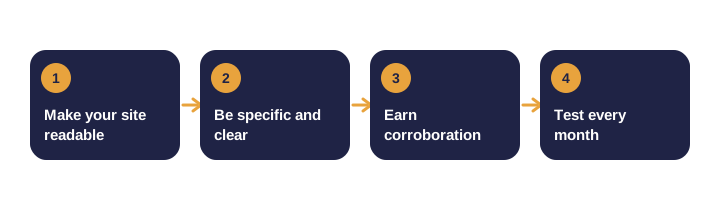
When someone asks an AI assistant, "Who is a good marketing agency for small ecommerce brands?", the answer is assembled from sources it can reach and believes.
Being one of those sources is now a real marketing goal. This guide shows how assistants choose, what to change on your site and off it, and how to measure progress.
How do AI assistants decide what to cite?
Each assistant works differently, and the systems change often. Still, a few patterns repeat across the major tools:
- Accessibility. If their crawlers cannot reach your page, they cannot cite it.
- Specificity. Pages that state what you do, for whom, where and with what evidence are easy to quote.
- Corroboration. When several independent sites describe you the same way, the assistant repeats it with more confidence.
- Clear structure. Headings, short answers and tables give clean passages to extract.
- Freshness. Dated pages with current figures are more useful for questions about today.
What should you change on your website?
- Write a clear about statement. In the first paragraph, say who you help, what you do and where you operate.
- Publish question-led content. Turn real customer questions into headings. People ask assistants in full sentences.
- Add structured data. Organization, article and FAQ markup help machines identify your business and its answers.
- Show expertise. Name the people behind the work, describe their experience honestly, and link to primary sources.
- Review crawl access. Check your robots file so the crawlers you want are not blocked by accident.
- Explain pricing and timelines. Assistants often answer "how much" and "how long" from these details.
What should you do off your site?
Consistency across the web matters as much as your own pages. Where details differ, assistants have to guess, and they often leave you out.
| Where | What to keep consistent |
|---|---|
| Google Business Profile | Name, services, location, hours, contact details |
| LinkedIn company page | Description, services, team, website link |
| Industry directories | Category, short description, current contact details |
| Review platforms | The same business name and service names as your site |
Then earn mentions that back up what you say about yourself:
- Customers who describe their results in their own words.
- Partners and associations that list you as a collaborator.
- Journalists who cite your original research or quote your experts.
- Events, podcasts and webinars that name your speakers.
How do you measure AI visibility?
There is no single dashboard for AI citations yet, so use a simple routine you can repeat every month.
- Choose ten questions your buyers actually ask.
- Ask the same questions in ChatGPT, Claude and Perplexity, using a fresh session each time.
- Record whether your brand appears, how it is described, which competitors appear beside it and which sources are named.
- Compare the results each quarter.
Pair this with search data. Branded search often rises after people hear about you in an AI answer, so watch that number in Search Console.
What does not work?
These methods rely on weaknesses that assistants and search engines are actively reducing. Clearly labeled advertising is different, but it does not create the organic trust this guide is about.
A practical 60-day plan
| Weeks | Action |
|---|---|
| 1 to 2 | Write your about statement, rewrite the top five pages, align business profiles |
| 3 to 4 | Publish one question-led guide, add FAQs to service pages, add structured data |
| 5 to 6 | Ask five customers for detailed reviews, pitch one piece of original insight |
| 7 to 8 | Run your first AI visibility check, choose the next two pages to improve |
What do buyers actually ask assistants?
- "Who is the best agency for [your service] in [your market]?"
- "How much should [your service] cost for a business my size?"
- "What is the difference between [your service] and [alternative]?"
- "Which companies have helped businesses like mine with [problem]?"
Example: a page that is easy to cite
| Element | Weak version | Citable version |
|---|---|---|
| Opening | Growth for your business | AI marketing and automation for small ecommerce brands |
| Pricing | Contact us for a quote | Monthly programs, with the scope and timeline explained |
| Proof | Happy clients | A named case with the method and the measured result |
| Location | Worldwide | Serving clients in specific markets, with the team base |
Glossary for this topic
| Term | What it means |
|---|---|
| Citation | A named mention or link to your brand in an answer |
| Corroboration | Independent sources confirming the same facts about you |
| Branded search | People searching for your company name directly |
| llms.txt | A plain file that summarizes your site for AI tools, if you choose to publish one |
Scenario: a dental practice asks about implants
- A patient asks an assistant which clinics near them offer implants.
- The clinic has a page that names the services, the location and the consultation process.
- The page is linked from the local directory and a reviewed patient story.
- The assistant can describe the clinic accurately, so the patient makes a call.
Myths and facts
| Myth | Fact |
|---|---|
| You can buy a citation | Organic citations come from trust and accurate public information |
| One assistant represents them all | Each assistant uses different sources and rules |
| Listing on many directories is enough | Consistency across fewer, accurate profiles works better |
| A llms.txt file guarantees visibility | It is optional and does not replace good content |
| Once cited, always cited | Visibility changes as sources and questions change |
Summary checklist
- Answer the main question early and clearly.
- Back up every claim with evidence or a named source.
- Measure progress against your own baseline.
- Review and update the work on a regular schedule.
Next steps
Start with the about statement, the FAQs on your key pages and a crawl-access review. Our team builds AI visibility plans as part of our AI-focused SEO service.
Also read our overview of what AI SEO is and how to start, and our guide to whether AI-generated content hurts SEO.
Frequently asked questions
Can I pay to be cited by ChatGPT or Claude?
Not in the organic answers. Assistants build answers from sources they find and trust, so the most reliable route is to be well described and well referenced across the web.
How do I know if my business is being cited?
Ask the questions your customers ask in each assistant, record the results monthly, and watch how your brand is described over time.
Do I need special files like llms.txt?
Some sites publish an llms.txt file to describe their content for AI tools. It can help, but it is no substitute for clear pages, accurate structured data and good third-party coverage.