Does AI Content Hurt SEO? Here Is What Google Actually Says

This is one of the most searched questions in SEO right now, and it is often answered with fear or hype. The reality is more practical.
Search engines reward helpful content and penalize content created mainly to manipulate rankings. How a page was produced matters less than what it does for the reader.
What have search engines said publicly?
Google's guidance on helpful content asks whether a page was written for people or to attract search traffic. It also asks:
- Does it show first-hand experience and real expertise?
- Does it answer the question completely, so the reader does not have to keep searching?
- Does it offer something other pages do not, such as original data or practical detail?
Where does AI content cause problems?
| Problem | What it looks like |
|---|---|
| Thin pages at scale | Hundreds of near-identical articles with swapped keywords |
| Inaccurate facts | Invented statistics, wrong dates, fake quotes |
| Missing experience | Generic advice that could fit any business |
| No quality control | Publishing faster than anyone can review |
| Misleading authorship | Bylines for experts who never reviewed the work |
Most of these problems existed before AI. AI simply makes them cheaper to produce, so the quality bar has to rise.
How do you publish AI-assisted content safely?
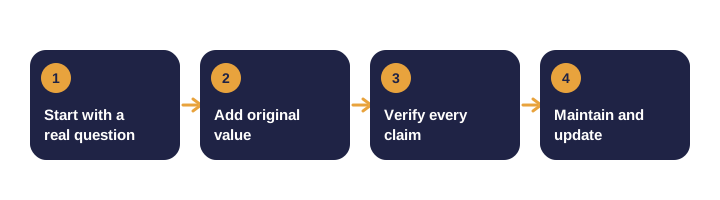
- Start with a real question. If you cannot name the reader and their problem, do not publish.
- Add original value. Include your own examples, process, data or lessons learned.
- Verify every claim. Link to primary sources and remove anything you cannot support.
- Name a responsible editor. Someone with subject knowledge should review and approve each piece.
- Match the depth to the query. Your page should answer at least as completely as the best current result.
- Maintain the content. Update pages when facts change, and retire pages that no longer help.
What does good versus weak look like?
| Weak page | Strong page |
|---|---|
| Opens with "payroll is important for every business" | Opens with the question and the three problems agencies face with contractors |
| Lists six features every provider offers | Compares providers against those problems in a table |
| Ends with "explore your options" | Names the trade-offs the author has seen and what to check before signing |
| No sources | Cites the official guidance it relies on |
How do you review AI-assisted content before publishing?
Use a short checklist for every piece:
- Is the main question answered in the first screen?
- Has every statistic been traced to its original source?
- Have names, dates, product details and quotes been checked line by line?
- Does any sentence read like it could appear in a competitor's article?
- Does the byline reflect a person who truly reviewed the work?
How do you handle updates and corrections?
- Set a review date for every important page.
- Check pages when guidance, prices or reports change.
- Fix errors visibly, with a dated note explaining the change.
- Update related pages that repeated the mistake.
What should a sensible AI content policy include?
| Area | Policy |
|---|---|
| Purpose | Every piece answers a defined reader question |
| Accuracy | Statistics are checked against named sources |
| Authorship | Bylines reflect people who reviewed the work |
| Originality | Each piece includes at least one element found nowhere else |
| Maintenance | High-traffic pages are reviewed every six to twelve months |
| Volume | Pace is set by editorial capacity, not tool capacity |
What is the bottom line?
AI does not hurt SEO by itself. Thin, inaccurate and mass-produced content does.
Use AI to speed up research and drafting, and invest human effort in expertise, accuracy and judgment.
Editorial red flags to watch for
- Sentences that could describe any company or any product.
- Statistics with no source, or a source that does not contain them.
- Lists of features copied from other sites.
- Quotes from experts who were never interviewed.
- Repeated phrases across many articles on the site.
Example disclosure statement
Terms to know
| Term | Meaning |
|---|---|
| Thin content | Pages with little original value for the reader |
| E-E-A-T | Experience, expertise, authority and trust, the qualities search guidance asks you to show |
| Manual action | A penalty applied by a search team after a review |
Scenario: an agency that scaled too fast
- It published sixty location pages in a month with near-identical text.
- Few pages earned impressions, and the site's overall visibility dropped.
- The team removed the weakest pages and rebuilt five strong location guides with local detail.
- The stronger pages recovered, and the lesson became the team's publishing rule.
Myths and facts
| Myth | Fact |
|---|---|
| Google bans all AI content | Guidance focuses on quality and helpfulness, not production method |
| Disclosing AI use always hurts rankings | Transparency builds trust; rankings depend on helpfulness |
| More pages means more traffic | Thin pages can dilute the value of the whole site |
| Editing a draft is enough | Editing must add evidence and experience, not just polish |
| Once it ranks, AI content is safe forever | Pages need updates as facts and guidance change |
Summary checklist
- Answer the main question early and clearly.
- Back up every claim with evidence or a named source.
- Measure progress against your own baseline.
- Review and update the work on a regular schedule.
How can LateNightBirds help?
Our content and SEO services start with audience questions, add the expertise and sources that make a page trustworthy, and include regular updates.
See our guide to the best AI tools for content marketing, and our overview of what AI SEO is and how to start.
Frequently asked questions
Will Google penalize AI content?
Search engines focus on content quality and helpfulness. Low-value, mass-produced pages are the risk, whether or not AI was used.
Should I label AI-written articles?
Be transparent where readers would expect it, and make sure a qualified person has reviewed the content for accuracy.
Can AI-assisted articles rank?
Yes, when they answer the question well, include real expertise and are accurate and well maintained.