AI SEO Explained: How to Win in Google and in AI Answers


People still type queries into Google. But a growing number now ask ChatGPT, Claude or Perplexity for a direct answer, and some never click through at all.
AI SEO is the practice of earning visibility in both places: the results page and the answer an AI assistant writes. This guide explains what it is and how to start.
What does AI SEO actually mean?
AI SEO is not a secret trick or a separate ranking system. It is a set of habits that make your website readable and trustworthy to search engines and to the AI models that summarize them.
Four habits do most of the work:
- Direct answers. Open each important section with a short, accurate answer.
- Original signals. Share your own data, case studies and first-hand experience.
- Entity clarity. Describe your brand the same way everywhere it appears.
- Technical access. Keep pages fast, readable without fragile scripts, and open to the crawlers you want.
How is AI SEO different from traditional SEO?
Traditional SEO still matters. AI SEO adds a layer on top: assistants combine several sources into one answer, so they favor specific, consistent and easy-to-attribute content.
| Area | Traditional SEO | AI SEO |
|---|---|---|
| Core goal | Rank a page for a keyword | Rank the page and be quoted in answers |
| Content shape | Long pages built around a keyword | Question-led sections with direct answers |
| Trust signals | Backlinks and domain authority | Backlinks, original data, named experts, consistent details |
| Measurement | Rankings and clicks | Rankings, clicks, branded search and AI mentions |
Why does AI SEO matter now?
- Zero-click answers. A buyer may learn your name from an AI summary before they ever visit your site.
- Detailed questions. Buyers ask comparison questions, and assistants answer them by weighing the sources they trust.
- Compounding trust. Early, reliable publishing builds an advantage that grows over time.
What should you do first?
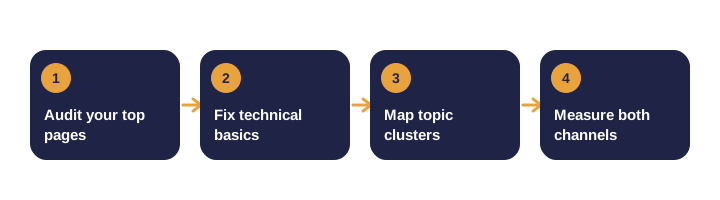
- Audit your top 20 pages. Check whether the first screen answers the page's main question. If not, rewrite the opening.
- Fix technical basics. Confirm indexing, mobile layout, load speed and a current sitemap.
- Add structured data. Use Organization markup for your company, Article markup for guides and FAQPage markup for real questions.
- Map topic clusters. Pick three to five core subjects. Create one pillar page for each and link supporting articles back to it.
- Publish with evidence. Add numbers, examples and sources. Describe how you got a result, not just the result.
- Make your details consistent. Use the same description, services and contact details on your site and your profiles.
- Measure both channels. Track rankings and clicks, then check your buyer questions in AI assistants each month.
How do you write content AI systems can use?
- Start each section with a plain-language answer in one or two sentences.
- Follow with the reasoning, steps or evidence.
- Use headings that match real questions, such as "How long does a site migration take?"
- Keep each paragraph to one idea.
- Trace every claim to something on the page or to a named source.
What are the common mistakes?
- Duplicated city pages with only the place name changed.
- Outdated statistics left in place for years.
- Anonymous content with no named author or reviewer.
What does a sensible 90-day plan look like?
| Month | Focus | Output |
|---|---|---|
| 1 | Audit and fixes | Top pages rewritten, technical issues resolved |
| 2 | One topic cluster | One pillar page and two supporting articles |
| 3 | Authority and review | A few relevant links, refreshed pages, first AI visibility check |
Is your page AI-ready? A quick checklist
- The main question is answered in the first two sentences.
- The page has one clear H1 and descriptive H2 headings.
- Key facts appear in the HTML, not only inside scripts.
- Claims link to a source, a method or a real example.
- Organization and article structured data are present and valid.
- The author or reviewer is named, with relevant experience.
- The page is dated and updated when facts change.
Before and after: rewriting an opening
| Version | Opening sentence |
|---|---|
| Before | We offer innovative marketing solutions for growing businesses. |
| After | We run AI-assisted SEO and automation programs for ecommerce and B2B companies, and we publish our audit method. |
Key terms explained
| Term | Meaning |
|---|---|
| Crawler | A bot that reads your pages so they can be indexed |
| Entity | A clearly defined thing, such as your company, a person or a product |
| Structured data | Labeled information that machines can read without guessing |
| Pillar page | A broad guide that links to detailed articles on one topic |
| Zero-click answer | An answer shown without the user visiting a website |
Myths and facts
| Myth | Fact |
|---|---|
| AI SEO is a separate discipline from SEO | It extends SEO, so the fundamentals still apply |
| Keyword density drives AI citations | Clarity, evidence and structure matter far more |
| Hidden text helps assistants read your page | Hidden text is a policy violation and carries risk |
| A single blog post is enough | Consistent coverage of a topic builds authority |
| Results appear in a week | Technical fixes can show quickly, but authority takes months |
Summary checklist
- Answer the main question early and clearly.
- Back up every claim with evidence or a named source.
- Measure progress against your own baseline.
- Review and update the work on a regular schedule.
How LateNightBirds can help
Our AI-focused SEO service covers the audit, technical fixes, topic planning and content production. We report in plain language so you can see what is working.
For a clear view of where you stand, book a free growth audit. For the AI side of this topic, read our guide on how to get cited by AI assistants.
Frequently asked questions
Is AI SEO the same as regular SEO?
No. AI SEO keeps the fundamentals of search optimization and adds the work of making content easy for AI systems to understand, trust and quote.
Does AI SEO replace keywords?
Keywords still matter as a way to understand what people search for. The difference is that you now plan around questions and topics, not isolated phrases.
How long does AI SEO take to show results?
Technical fixes can be picked up within weeks. Content authority and AI citations usually take several months of consistent publishing and outreach.