The Best AI Tools for Content Marketing (and How to Use Them Well)


AI has changed how content teams work. Research that took days can start in an afternoon, and one long article can become a newsletter, a social series and a video script in a single session.
The risk is publishing faster than you can check accuracy and quality. This guide explains which tools help, how to choose them, and where people must stay in control.
What are AI tools good at?
Think of AI as a capable assistant for specific tasks, not as the author.
| Use | What AI does | Example |
|---|---|---|
| Research support | Summarizes sources and finds gaps | Summarize ten reports into themes |
| Question discovery | Clusters customer questions | Group 300 support tickets by topic |
| Outlines | Suggests headings and section questions | A structure for a pillar page |
| Drafting support | Writes routine sections | Definitions or meta descriptions |
| Editing | Flags clarity, repetition and jargon | Readability pass before review |
| Repurposing | Adapts one piece into many formats | Guide to newsletter and carousel |
| Reporting | Summarizes performance data | Plain-language monthly summary |
| Accessibility | Drafts alt text and captions | Image descriptions and transcripts |
How should you choose a tool?
- Start with the workflow. Name the task before you compare products.
- Check data handling. Find out whether your content trains the vendor's models and where data is stored.
- Test on real work. Measure time saved, corrections needed and final quality.
- Confirm integrations. Connect to your CMS, analytics and project tools.
- Keep control of output. Set a style guide and review every change.
- Plan for change. Document your workflow so you can switch tools later.
Which categories matter most?
| Category | Typical use | What to check |
|---|---|---|
| General AI assistants | Research, outlines, drafting, editing | Data policy and consistency of tone |
| SEO research tools | Topic discovery and competitor analysis | Data sources and real search demand |
| Writing and grammar tools | Clarity and style checks | Ability to set a house style |
| Design and image tools | Social graphics and covers | Brand kit and image licensing |
| Video and audio tools | Captions, clips and voiceovers | Transcription accuracy and voice consent |
| Analytics tools | Performance summaries | Connections to your data sources |
Where must people stay in control?
- Fact-checking every claim.
- Adding firsthand experience and original examples.
- Approving tone and brand voice.
- Deciding what is worth publishing.
- Taking responsibility for the final result.
Search engines focus on quality and helpfulness, not on how a draft was produced. Readers notice generic writing quickly.
A responsible workflow, step by step
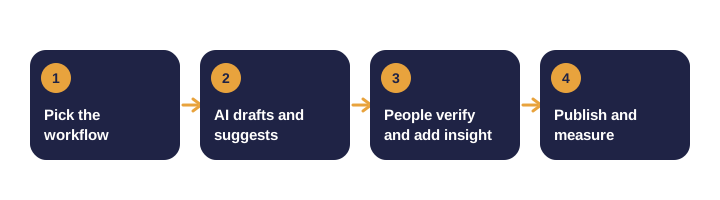
| Step | AI can help with | A person must |
|---|---|---|
| Research | Summarize sources, surface themes | Verify sources and pick the angle |
| Outline | Propose structure | Confirm the audience and promise |
| Draft | Write routine sections | Add experience and opinion |
| Edit | Suggest clarity fixes | Check facts, names and claims |
| Publish | Generate metadata and alt text | Approve and schedule |
| Report | Summarize performance | Decide what to change |
What are the common mistakes?
- Losing your voice. Keep a voice guide and edit toward it.
- Unverified statistics. Confident but wrong numbers damage trust.
- No record of review. Log who checked each piece and what changed.
Should you disclose AI assistance?
Disclose when readers would reasonably expect to know, such as when a piece presents itself as a personal account. A short statement about your editorial process is often enough.
A simple tool scorecard
| Criterion | Question to ask | Score (1 to 5) |
|---|---|---|
| Fit | Does it solve the workflow we named? | |
| Data safety | Is our content excluded from training and securely stored? | |
| Integration | Does it connect to our CMS and analytics? | |
| Control | Can we set a style guide and review changes? | |
| Cost | Does the price fit the time it saves? |
Useful editing requests
- "Shorten this section to 80 words without losing the main point."
- "List every claim in this draft that needs a source."
- "Rewrite this paragraph for a reader who has never heard the term."
- "Suggest three headings that match how buyers phrase this question."
Glossary
| Term | Meaning |
|---|---|
| Model | The AI system that generates text, images or other output |
| Hallucination | A confident answer that is not supported by facts |
| Style guide | Written rules for tone, terms and formatting |
Scenario: a two-person content team
- They use an assistant to summarize twenty source reports into a research brief.
- The writer drafts the article and adds two original examples from client work.
- The editor checks every number against its source and rewrites the introduction.
- The same article is repurposed into a newsletter and a carousel, with the editor approving each version.
Your action list for this week
- List the one workflow in your team that wastes the most time.
- Test one tool on a real project and log the time it saves.
- Write a short style guide that any tool or writer must follow.
- Create a review checklist that every AI-assisted piece must pass.
Myths and facts
| Myth | Fact |
|---|---|
| AI makes writing unnecessary | People still provide the judgment, experience and accountability |
| The most expensive tool is the best | Fit to your workflow matters more than price |
| AI output is ready to publish | Every output needs review for facts, tone and claims |
| One tool can do the whole workflow | Most teams combine several tools with clear roles |
| Readers cannot tell AI writing apart | Generic phrasing is easy to spot, which hurts trust |
Summary checklist
- Answer the main question early and clearly.
- Back up every claim with evidence or a named source.
- Measure progress against your own baseline.
- Review and update the work on a regular schedule.
How we use AI at LateNightBirds
We use AI for research, outlining, drafting support, editing and reporting. Our editors own every final piece, check every statistic against its source, and rewrite anything that sounds generic.
Read our content and SEO services for details, or see whether AI-generated content hurts SEO for the search side.
Frequently asked questions
Which AI tool is best for content marketing?
There is no single best tool. Choose based on the workflow you want to improve, your data requirements and how well the tool fits your existing systems.
Do I need to disclose AI use?
Disclosure is good practice when readers would reasonably expect to know. Describe your editorial process honestly and keep humans accountable for accuracy.
Can AI replace a content writer?
AI can support writers with research and drafts, but original insight, judgment and accountability still come from people.