Content Marketing That Converts: A Step-by-Step Strategy


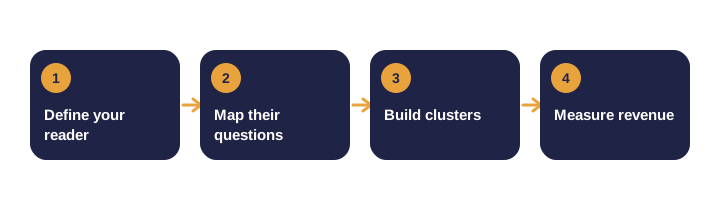
Content marketing works when every piece has a job. Some articles bring in visitors, some build trust, and some help a buyer decide.
Without a plan, teams publish whatever is easiest and wonder why nothing converts. This seven-step process fixes that.
Step 1: Define who you are writing for
Write a one-page profile of your ideal customer. Include:
- Role and company size
- The problems they are trying to solve
- The words they use to describe those problems
- The objections they raise and the sources they trust
Step 2: Map the questions your buyers ask
Good topics come from real questions. Collect them from sales calls, support tickets, reviews, forums and search tools. Keep the exact wording, because it often makes the best headline.
| Stage | Question type | Example |
|---|---|---|
| Awareness | "What is" and "why does" | Why do my website leads go cold after one email? |
| Consideration | "How to" and "best way to" | How do I set up a lead follow-up sequence? |
| Decision | "How much," "compare," "alternatives" | How much does a content agency cost? |
Step 3: Choose core topics and build clusters
Pick three to five topics that connect directly to your services. For each one:
- Write one pillar page that covers the subject at a useful depth.
- Write supporting articles on specific questions.
- Link each supporting article to the pillar and to related articles.
Step 4: Plan a realistic calendar
A calendar you can keep beats an ambitious one you abandon. Many businesses do well with two strong articles a month plus one meaningful update.
| Week | Activity |
|---|---|
| 1 | Research, gather questions and sources, outline |
| 2 | Draft with examples and original detail |
| 3 | Edit, fact-check, add links and images |
| 4 | Publish, distribute, record baseline metrics |
Step 5: Create content that earns trust
- Open with a direct answer. Put the answer in the first paragraph.
- Support claims with evidence. Use examples, data or cited sources.
- Show who wrote it. Name the author and the experience behind the advice.
- Be complete. A reader should not need to leave to learn the basics.
- End with one next step that matches the reader's stage.
Step 6: Distribute and repurpose
Publishing is only half the work. Share each piece where your audience already is:
- Your email list
- LinkedIn and relevant communities
- Partner newsletters
- A short version sent to people who asked the question on a sales call
Turn strong articles into short videos, checklists or social threads. Update top performers every six to twelve months.
Step 7: Measure what matters
| Question | Metric to watch |
|---|---|
| Are we reaching the right people? | Organic impressions and visits from target queries |
| Are we earning trust? | Return visits, time on page, email sign-ups |
| Are we generating demand? | Leads and booked calls from content touchpoints |
| Are we improving? | Pages that gain rankings after refreshes |
Common mistakes to avoid
- Writing about everything. Focus builds authority.
- Ignoring sales. The questions salespeople hear every week are free research.
- No distribution plan. Great content nobody sees earns nothing.
- Forgetting updates. Old statistics quietly reduce trust.
A content brief template
| Field | What to write |
|---|---|
| Target reader | The role and problem from your profile |
| Main question | The exact question the article answers |
| Stage | Awareness, consideration or decision |
| Key points | Three to five points the reader must leave with |
| Evidence | Data, examples and sources you will use |
| Next step | The one action the reader should take |
Headline formulas that work
- How to [result] without [pain]
- [Number] [things] that [outcome]
- [Question] and what to do about it
- The complete guide to [topic] for [audience]
Content terms you will hear
| Term | Meaning |
|---|---|
| Topic cluster | A pillar page plus the articles that support it |
| Content refresh | Updating an older page to improve its results |
| Assisted conversion | A sale where content played a part earlier in the journey |
Scenario: a bookkeeping firm with two buyer types
- The team writes separate profiles for sole traders and growing companies.
- Sales notes reveal the same objection: "Will this take my time?"
- A guide answers that question with a checklist and a timeline.
- Sales staff send the guide after discovery calls, and the link is tracked to booked meetings.
Your action list for this week
- Write a one-page profile of your most valuable customer.
- Ask your sales team for the five questions they hear most often.
- Choose one topic cluster and outline its pillar page.
- Book the first two articles in your calendar with owners and dates.
Which format fits which buyer stage?
| Stage | Best formats | Job of the content |
|---|---|---|
| Awareness | Explainer articles, short videos, checklists | Name the problem and build trust |
| Consideration | How-to guides, comparison pages, templates | Show approaches and their trade-offs |
| Decision | Case studies, pricing explanations, consultation pages | Remove doubt and prompt a conversation |
Myths and facts
| Myth | Fact |
|---|---|
| Content is a cost, not an asset | Well-made content keeps earning traffic and leads |
| Viral posts create customers | Relevant articles for buyers usually convert better |
| You need to post every day | Two strong articles a month can outperform daily thin posts |
| Promotion is optional | Distribution decides who ever sees the content |
| Once published, the work is done | Updates keep older pages competitive |
Summary checklist
- Answer the main question early and clearly.
- Back up every claim with evidence or a named source.
- Measure progress against your own baseline.
- Review and update the work on a regular schedule.
Where to begin
Pick one cluster this month, write its pillar and two supporting articles, and measure for a quarter. Our content and link acquisition service handles research, writing, distribution and reporting.
For the link side, see ethical link building, and for timing expectations, how long SEO takes.
Frequently asked questions
How many articles do I need to see results?
It depends on competition, but a focused cluster of well-made articles usually does more than many scattered posts.
Should I write for SEO or for people?
Both. Write for the specific person you described, and use search data to make sure the topic matches what people are looking for.
How often should I update old content?
Review your most important pages every six to twelve months and refresh facts, examples and internal links.