How Long Does SEO Really Take? A Realistic Timeline, No Hype


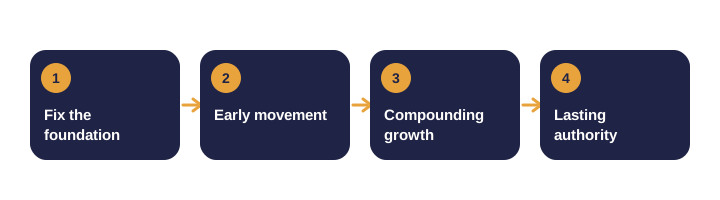
"How long until SEO works?" is the first question most owners ask. The honest answer is: it depends on where you start and how hard the competition is.
The stages below describe common patterns. They are ranges, not promises.
What is a realistic timeline?
| Stage | Typical timing | What you should see |
|---|---|---|
| Foundation | Weeks 1 to 4 | Technical issues fixed, pages indexed, tracking in place |
| Early movement | Months 2 to 4 | Rankings rise for less competitive queries, impressions grow |
| Compounding | Months 4 to 9 | Steady traffic growth, first organic conversions |
| Authority | Months 9 and beyond | Competitive terms begin to move, branded searches rise |
What makes SEO faster or slower?
- Competition. Strong sites already ranking for your queries take longer to beat.
- Site health. Crawl errors, slow pages and duplicate content slow everything down.
- Content quality. Clearer, more complete answers climb faster.
- Link profile. Relevant, trusted links accelerate growth on hard terms.
- Topic focus. Consistent publishing on one subject builds authority faster.
- Consistency. Long gaps stall momentum.
- Search changes. Updates can shift rankings for weeks.
Which metrics show progress early?
Traffic lags behind the work. In the first months, watch these measures instead:
- Indexed pages and crawl errors in Search Console.
- Impressions for target queries, which often rise before clicks.
- Average position for 20 to 30 priority keywords, tracked monthly.
- Click-through rate on pages that already appear in results.
- Organic leads, even if small.
How do you set realistic goals?
Record a baseline first, then set quarterly goals.
| Good goal | Why it works |
|---|---|
| Grow impressions for 25 priority queries by 50% in six months | Measurable and within your control |
| Publish two pillar-level guides per quarter | Output you can plan and verify |
| Fix all crawl errors within 30 days | Clear and finishable |
What are the warning signs?
- Promises of top rankings within a month.
- Only blog posts, with no technical review.
- Sudden link growth from unrelated sites.
- Traffic that spikes and then collapses.
Any of these can signal shortcuts that carry penalty risk. Ask your provider to show the source of every link they claim to have earned.
How can you speed things up honestly?
- Fix technical basics first.
- Choose a focused set of topics you can own.
- Answer real questions in depth.
- Update older pages that already get impressions.
- Earn a few relevant links through original work.
- Write clearer titles and descriptions to lift click-through rates.
What should you expect from an SEO provider?
| A good provider will | A warning sign is |
|---|---|
| Start with an audit and explain priorities | Starting with a sales pitch and no audit |
| Report monthly in plain language | Reports full of jargon and vanity numbers |
| Tell you when results are not yet visible | Guaranteed positions |
| Explain what is outside their control | No mention of competitors or search changes |
How do local and ecommerce sites differ?
Local service businesses have fewer valuable queries, usually tied to a location. A verified Google Business Profile, clear service pages, real reviews and consistent citations can show results within a few months.
Ecommerce stores have thousands of pages and face large competitors. Progress usually comes from fixing technical issues across the catalog, writing useful category descriptions and publishing buyer guides. These projects take longer, but the payoff can be significant.
Example timeline for a small local business
| Period | Work completed | Result to expect |
|---|---|---|
| Month 1 | Profile fixes, service pages, technical cleanup | Pages indexed, errors cleared |
| Months 2 to 3 | Area pages, reviews requested, first guides | Impressions rise for local searches |
| Months 4 to 6 | More guides, citations corrected, steady reviews | First calls from organic search |
| Months 7 to 12 | Refresh older pages, add case studies | Steady monthly leads from search |
Glossary of SEO metrics
| Metric | Plain meaning |
|---|---|
| Indexing | Search engines have stored the page and can show it |
| Impression | A search result showing your page to a user |
| Average position | Where your page usually appears for a query |
| Click-through rate | The share of impressions that become clicks |
Questions to ask before you hire an SEO provider
- What will you audit in the first 30 days?
- Which metrics will you report, and how often?
- How do you choose topics and earn links?
- What would make you recommend stopping a tactic?
Scenario: a software startup in a crowded market
- The team starts by fixing indexing problems and rewriting its product pages.
- It publishes one comparison guide and one setup tutorial each month.
- Early gains come from long-tail questions that competitors ignore.
- Competitive terms move slowly, so the team focuses on the leads it can win now.
Your action list for this week
- Record your current indexed pages, impressions and organic leads.
- Pick 25 priority queries and note your current position for each.
- Fix the top three technical issues in your search console report.
- Schedule a monthly review to compare progress against the baseline.
Myths and facts
| Myth | Fact |
|---|---|
| SEO results appear overnight | Most programs show progress over months |
| Rankings equal success | Qualified leads and revenue matter more than position alone |
| More content always helps | Better, more complete content helps more than volume |
| A penalty is always the cause of a drop | Most drops come from competition, technical issues or search changes |
| Once you rank, you stay there | Rankings need ongoing maintenance and updates |
Summary checklist
- Answer the main question early and clearly.
- Back up every claim with evidence or a named source.
- Measure progress against your own baseline.
- Review and update the work on a regular schedule.
Next steps
If you want an honest estimate for your own site, our AI-focused SEO service starts with a review of your current position. Book a free growth audit to begin.
For more depth, read our guides on content marketing strategy and ethical link building.
Frequently asked questions
Can SEO show results in 30 days?
Some technical fixes and quick wins can appear within a month. Meaningful traffic and lead growth usually takes several months.
Why did my rankings drop after an update?
Search engines adjust rankings often. Check for technical problems, thin content or lost links, and compare your pages against the ones now ranking higher.
Should I pay for SEO monthly?
Ongoing SEO is normal because search keeps changing, but the scope should be clear: audits, content, technical work and reporting you can understand.